
By Rinat Shaykhutdinov, founder of Watasu.
Render became the go-to Heroku replacement for a reason: connect a Git repository, and minutes later your web services, background workers and databases are live with free SSL and custom domains.
If you want an always-on app in Germany with managed Postgres and predictable euro bills, start with Watasu. Apps start at €8/month and teams pay no per-seat fees. Render is still a useful option for a free prototype.
This guide compares the best Render alternatives on pricing, free tier limits, managed databases and data residency, so you can choose the right platform for your small team or growing startup.
What is Render?
Render is a fully managed platform (PaaS) for running backend and frontend code without infrastructure management. When people ask “what is Render backend?”, they usually mean the services Render hosts for you.
Render offers web services, private services, background workers, cron jobs, static sites, managed PostgreSQL and Key Value, a Redis-compatible key value store. Supported features vary by service type and configuration. For example, a persistent disk limits a service to one instance and disables zero-downtime deploys.
Infrastructure as code is built in through Blueprints: a single render.yaml file describes your services and databases. Static sites are served from a global CDN, and web services on Pro plans can autoscale based on CPU and memory.
Is Render totally free?
Render offers free instances for eligible workloads. For an always-on web service, budget for paid compute.
A free instance spins down after 15 minutes without inbound traffic and takes about a minute to wake up, so cold starts are part of the deal. Free web services get 750 instance hours per month, cannot scale beyond one instance and cannot use persistent disks.
The free Postgres database has 1 GB of storage and expires 30 days after creation. Free Key Value is in-memory only, so data is lost on restart. Cron jobs, background workers and private services are not available on the free instance type at all.
The Hobby plan includes 5 GB of bandwidth and 500 build minutes per month. It is a generous free tier for prototypes, but a poor fit for anything customers depend on.
Render pricing in 2026
Render’s plans combine a workspace plan fee with compute billed per service:
| Plan | Plan fee | Bandwidth | Build minutes |
|---|---|---|---|
| Hobby | $0 + compute | 5 GB | 500 |
| Pro | $25 + compute | 25 GB | 1,000 |
| Scale | $499 + compute | 1 TB | 5,000 |
| Enterprise | Custom | Custom | Custom |
Compute starts at $7/month per service for 512 MB of resources and $25/month for 1 CPU and 2 GB. Paid Postgres compute starts at $6/month before storage, Key Value starts at $10, and persistent disks cost $0.25 per GB.
Overages add up: bandwidth costs $0.15 per extra GB, and build minutes cost $5 per 1,000. The Hobby plan includes 2 custom domains; extra custom domains cost $0.25 each per month.
A typical stack on the Pro plan – one web service, one worker and a database – already costs $25 + $25 + $7 + $6 = $63 a month before database storage, bandwidth overages, and other extras.
Why developers look for Render alternatives
Per service pricing. All services – web, worker, cron job and database – are billed separately, so costs multiply as your architecture grows into small services.
Cold starts. The free tier sleeps, and upgrading every preview, internal tool and side service to always-on compute adds up fast.
Bandwidth and build minutes. Bandwidth limits were cut in 2026, and build minutes are metered for every build.
Data location. Render has a Frankfurt region, but it is a US company. For EU teams that sell to regulated customers, that can matter as much as price.
Reliability. No provider is immune to platform outages, and teams with uptime commitments want options.
What to look for in a Render alternative
Pricing model. Decide whether you want to pay per service, pay per server or pay for measured usage. Render’s per service billing is simple for one app, but costs grow with every worker and database you add. If you run two platforms today – one for frontends, one for backend web services and databases – check whether a single PaaS can deploy apps of both kinds.
Built in services. Check which databases, caches, object storage and monitoring are built in, and which you would have to buy from other services.
Deployment workflow. Git push deploys, preview environments, health checks and rollbacks should feel at least as easy as on Render.
Scale and resources. Look at how each platform lets you scale resources horizontally and vertically, and whether autoscaling requires an enterprise plan. On Render, autoscaling starts at Pro.
Data and vendor lock in. Prefer platforms built on standard pieces – Docker, Procfiles, Postgres – so moving later is easy, and check where your data is stored. For a small team, that flexibility is worth more than any single feature.
Render alternatives at a glance
| Platform | Entry price | Free tier | Best for |
|---|---|---|---|
| Watasu | €8/mo app, €5/mo Postgres | No (prepaid from €5) | EU startups, predictable pricing |
| Railway | $5/mo Hobby | Free plan with $1/mo usage after trial | Visual canvas |
| Fly.io | Varies by region and size | Limited trial | Global low latency |
| Heroku | $5/mo Eco | No | Existing Heroku teams |
| DigitalOcean App Platform | $5/mo | 3 static sites | DigitalOcean users |
| Northflank | Usage-based | Sandbox | Bring your own cloud |
| Sliplane | €9/mo per server | No | Fixed price, many containers |
| Coolify, Dokploy, Temps | Server cost | Free software | Self host, full control |
The best Render alternatives in 2026
1. Watasu – predictable pricing, EU-resident
Watasu is a fully managed platform for apps and AI agents that runs entirely in EU data centres in Germany. It covers the same ground as Render – web services, background workers, managed databases and object storage – with euro pricing and no bandwidth bills for normal traffic.
Deployment is git based. Connect a GitHub repository to deploy on every push, or deploy with the CLI:
watasu create my-app
git push watasu main
The platform handles builds with your Dockerfile or Cloud Native Buildpacks, so Docker support and minimal configuration come together. A Procfile declares web and worker processes, private services on a private network, and a release step for migrations.
Predictable pricing. The Watasu rate card lists Hobby at €8/month and Standard 1× at €15/month for 1 vCPU and 2 GiB. Dynamic pods bill measured use up to a monthly ceiling. Billing is prepaid in euros, with no per-seat fees. Normal app bandwidth is included, and object storage has a separate transfer allowance.
Builds cost €0.50 per hour, billed per second, so you pay only for the build seconds you use – there is no monthly build minutes quota to track.
Included on every plan: custom domains with free SSL, streaming logs, GitHub integration and pipeline tools, and multi-zone placement for apps with two or more replicas. Unlike Render’s Hobby plan, there is no limit of two custom domains.
Managed databases. Managed Postgres starts at €5/month, with read replicas and scheduled backups available on eligible plans, Valkey (key value, Redis-compatible) at €1, and S3-compatible object storage at €2. ClickHouse, Redpanda and Qdrant are one command away too.
GitHub integration is built in, and each app gets built in monitoring through Grafana, with logs, metrics and traces. Review apps are built in too, with preview environments for every pull request, and dashboards can live in your repository as code.
Where Watasu is not the right fit (yet): there is no free tier, no persistent disks for app containers, no built-in cron scheduler, and one region (EU). Long running tasks and batch jobs run as worker processes.
2. Railway
Railway lets you deploy from a visual canvas, with app templates and usage-based paid plans from $5/month. In October 2026 Railway reported that an attacker decrypted some customer environment variables, so review our Railway alternatives guide first.
3. Fly.io
Fly.io runs containers as Fly Machines across multiple regions. Pricing depends on machine size, region, and usage. Fly.io offers a limited trial for evaluation.
4. Heroku
Heroku invented the deployment workflow that Render later refined, but Heroku remains supported and has shipped updates since announcing its sustaining engineering model. Eco dynos cost $5/month and sleep after inactivity. See the Heroku alternatives guide for more.
5. DigitalOcean App Platform
DigitalOcean App Platform deploys apps and static sites from Git, with three free static sites, and you pay from $5/month for containers. It integrates with other DigitalOcean services such as managed databases and Spaces object storage, so teams can keep services and data on one bill.
6. Northflank
Northflank combines managed services with bring-your-own-cloud for all your services: you can deploy it in your own AWS, GCP or Azure account. It supports CI CD pipelines, preview environments and jobs, with a free sandbox tier.
7. Sliplane
Sliplane offers fixed pricing per server rather than per service, regardless of how many services you run, which keeps costs flat: from €9/month you can deploy many containers on one server in European data centres. You run databases as containers yourself, so there are no managed databases.
8. Self host: Coolify, Dokploy and Temps
If you want to self host, open-source tools give you a Render-like UI for services on your own server. Coolify and Dokploy both offer a free self hosted option and a paid cloud dashboard. Temps is a newer self hosted alternative to Render with analytics and error tracking built in.
Budget for the servers and the time it takes to patch them, manage backups, and monitor the services.
How to migrate from Render to Watasu
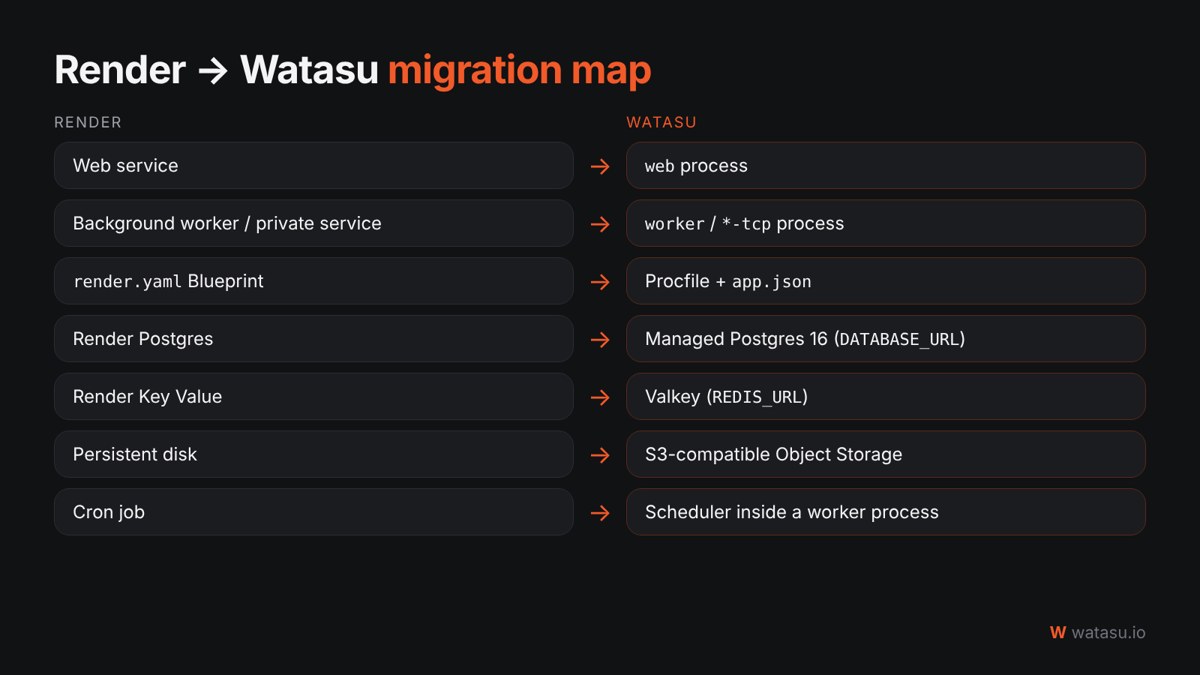
Rehearse the move in staging before you switch production traffic.
- Create an app with
watasu createand connect your Git repository. - Translate
render.yamlservices into Procfile processes: web, worker, release. - Import ordinary settings separately from runtime secrets. Use the connection variables injected by Watasu for managed databases. Keep local environment files out of Git.
- Restore a
pg_dumpof Render’s managed PostgreSQL into Watasu Postgres; move Key Value to Valkey. - Move files from persistent disks to object storage, and cron jobs into a worker scheduler.
- Rehearse the database restore and verify workers and scheduled jobs. When ready, pause writes as needed, move the final data, update DNS, and verify HTTPS and app health.
Which Render alternative should you choose?
Render is still a solid choice for static sites and simple services. Choose Render if its free tier fits your prototype. It also offers a Frankfurt region. For always-on workloads, estimate the bill for your full stack before you choose. Otherwise, the right Render alternative depends on your team:
- EU startup that wants fixed euro costs: Watasu.
- Global users: Fly.io.
- Many small containers on one bill: Sliplane.
- Your own cloud account: Northflank.
- Full control and DevOps time: Coolify, Dokploy or Temps.
Render made deployment easy. Watasu keeps that easy deployment, adds predictable euro pricing and keeps your data in the EU. Create a Watasu account and deploy your first app today.
Frequently asked questions
What is Render?
Render is a managed platform for web services, workers, scheduled jobs, static sites, PostgreSQL, and Redis-compatible Key Value.
Is Render totally free?
Render offers free instances for eligible workloads. Free web services sleep after inactivity, and free PostgreSQL databases expire after 30 days.
How much does Render cost?
Render lists Hobby at $0, Pro at $25/month, and Scale at $499/month before compute. Paid web compute starts at $7/month. Storage, extra bandwidth, and extra build minutes can add to the bill.