
By Rinat Shaykhutdinov, founder of Watasu.
For over a decade, Heroku was the default answer to “how do I ship this?” Developers would deploy with git push heroku main, and a few seconds later their apps were live – no servers to patch or manage, no load balancers to configure. A whole generation of developers learned deployment on Heroku.
Watasu is a close fit if you want to keep Git deploys, Procfiles, and review apps while running your app and managed Postgres in Germany. Apps start at €8/month, and there are no per-seat fees. You can also choose a provider that runs workloads in your own cloud account or manage servers yourself.
Is Heroku end of life?
Heroku announced a sustaining engineering model in February 2026. Existing apps, pipelines, teams, and add-ons remained supported, and the announcement said new Enterprise Account contracts would no longer be offered. Heroku subsequently announced new platform features in October. For a migration decision, compare the cost of your actual dynos and add-ons, the regions you need, and the work required to move your data.
What can you do with Heroku?
Heroku remains a capable PaaS service to deploy web apps, APIs and background workers without touching servers. Its core features still work:
- Git-based deployment and GitHub integration, with buildpacks for Node, Ruby, Python, Go, Java and PHP;
- dynos for web and worker processes, with horizontal scaling;
- pipelines and review apps – preview environments for every pull request;
- environment settings for secrets and configuration;
- a marketplace of Heroku add ons for databases, monitoring, logging and email;
- the Heroku Scheduler service for cron jobs.
Is Heroku free for hosting?
No. Heroku has no free hosting today: it ended its free tier on November 28, 2022. The cheapest paid option is an Eco dyno at $5/month, which sleeps after inactivity; Basic costs $7 and Standard-1X costs $25 per month. Postgres and other add ons are billed separately.
If you want a free alternative for hobby projects, Render still has a free tier, and self hosted tools cost only the servers they run on.
What to look for in a Heroku alternative
Before comparing platforms, decide which of these matter most for your team:
- Developer velocity. Can developers still
git pushto deploy and get a running app with logs, monitoring and preview environments? - Managed databases. Postgres, Redis-compatible caches and automated backups, so you do not have to manage servers for data.
- Infrastructure control. Do you want a fully managed service, a platform inside your own AWS account, or full control on your own VPS?
- Scaling. Horizontal scaling per process, multiple zones, and resources that grow with traffic.
- Pricing model. Fixed plans, usage billing or a platform fee on top of your cloud bill.
- Data location. For European companies, where data lives – and which law applies to the service provider – can be a deal breaker.
Heroku alternatives compared
| Platform | Type | Entry price | Free tier | Best for |
|---|---|---|---|---|
| Watasu | Managed PaaS, EU-resident | €8/mo app, €5/mo Postgres | No (prepaid from €5) | EU startups, Heroku-style workflow |
| Render | Managed PaaS | $7/mo (512 MB) | Yes | Small apps, static sites |
| Fly.io | Global micro-VMs | Varies by region and size | Limited trial | Global low latency |
| Railway | Managed PaaS | $5/mo Hobby | 30-day trial | Visual canvas |
| DigitalOcean App Platform | Managed PaaS | $5/mo | 3 static sites | DigitalOcean users |
| Vercel | Frontend + serverless | $20/mo Pro | Hobby (non-commercial) | Frontend-heavy Node apps |
| Northflank | Managed or BYOC | Usage-based | Sandbox | Teams with their own cloud |
| Dokku, Coolify, CapRover, Kamal | Self hosted | Server cost | Free software | Full control, internal tools |
Every alternative here covers the basics of web hosting: git-based deployment, HTTPS, logs and scaling. The differences show up in three places – who has to manage the infrastructure, how integration with databases and monitoring works, and how the hosting bill grows with traffic. Managed PaaS hosting is the fastest way for developers to replace Heroku; BYOC trades convenience for control; self hosted tools give developers full control at the cost of operations work.
The best Heroku alternatives in 2026
1. Watasu – the Heroku model, EU-resident and actively developed
Watasu is a managed hosting service that keeps everything developers loved about Heroku and runs it entirely on EU infrastructure, in data centres in Germany. If your developers know Heroku, there is almost nothing to relearn and no servers to manage:
watasu create my-app
git push watasu main
You push code, Watasu builds it from your Dockerfile or with Cloud Native Buildpacks (Node, Python, Ruby, Go, Elixir, PHP), and streams the build and deployment to your terminal. Many apps can reuse their Procfile after checking runtime and build dependencies: web processes get automatic HTTPS, worker processes run background jobs, and a release process runs migrations before each rollout.
Integration with GitHub is built in: connect a repository and every code push to a branch triggers a new deployment. Familiar features are all there:
- Config vars with a secret mode – secret values are masked for non-owners and never passed to builds.
- Pipelines and review apps – a preview environment for each pull request, and promotion of the exact image that passed staging.
- Add-ons you manage from the CLI – PostgreSQL from €5/month, with read replicas and scheduled backups available on eligible plans, plus Valkey (Redis-compatible), ClickHouse, Redpanda, Qdrant and S3-compatible object storage.
- Private networking between apps through
*-tcpprocesses that only trusted apps can reach. - Monitoring – a Grafana workspace per app with logs, metrics and OpenTelemetry traces.
The Watasu rate card lists Hobby at €8/month and Standard 1× at €15/month for 1 vCPU and 2 GiB. Dynamic pods bill measured use up to a monthly ceiling. Billing is prepaid in euros, with no per-seat fees. Normal app bandwidth is included, and object storage has a separate transfer allowance.
Where Watasu is not the right fit (yet):
- no free tier
- one region (EU, Germany)
- no SOC 2 yet
- no built-in Heroku Scheduler equivalent – cron jobs run inside a worker process
For AI products, Watasu also offers isolated sandboxes for agents and an MCP server, so assistants can inspect apps and query logs.
Best for:
- EU startups and full stack developers that want the Heroku workflow
- teams that need GDPR-friendly hosting and predictable euro pricing
2. Render
Render is a managed platform where you can administer services from one dashboard. It supports web services, background workers, cron jobs, static sites and managed Postgres, with automatic deployments on every git push. Compute starts at $7/month for 512 MB on a free Hobby workspace; team plans cost $25/month plus compute.
Pros:
- a real free tier
- simple UX
- a Frankfurt region and GitHub integration
Cons:
- free services sleep
- bandwidth limits were cut in 2026
- US company
Best for:
- small apps
- full stack Node and Rails projects
3. Fly.io
Fly.io runs containers as Fly Machines across multiple regions. Pricing depends on machine size, region, and usage. Fly.io offers a limited trial for evaluation.
Pros:
- global deployment and scaling with low latency
- strong for Node and Rails
- a WireGuard mesh between regions
Cons:
- more operational surface area than Heroku
- price managed Postgres and storage separately
Best for:
- latency-sensitive apps with users on several continents
4. Railway
Railway offers a drag-and-drop canvas for apps and databases, app templates for common stacks, and usage-based paid plans from $5/month. In October 2026, however, Railway reported that an attacker decrypted some customer environment variables. Railway’s own post on the incident is worth reading, as is our Railway alternatives guide, before you commit.
5. DigitalOcean App Platform
DigitalOcean App Platform is a managed alternative built on top of Digital Ocean infrastructure. It handles deployment through GitHub integration, offers three free static sites, and lets you deploy containers from $5/month next to managed databases and other resources.
Best for:
- projects already hosting on Digital Ocean that want servers, databases and apps on one bill
6. Vercel
Vercel is ideal for frontend-heavy Node apps such as Next.js, with serverless functions, edge caching and DDoS protection built in. The Pro plan costs $20/month per seat plus usage. It is not designed for persistent services like long-running workers or databases, so most developers pair it with a separate backend hosting service.
7. Northflank and BYOC platforms
If you want a managed service but your own cloud account, look at a bring-your-own-cloud alternative. Northflank can deploy workloads to a cluster in your own cloud account, giving you infrastructure control and keeping data in your own cloud. Similar tools deploy into your own AWS account on top of AWS services like ECS or EKS. Tools in this category usually charge a platform fee on top of your AWS bill, and you still need some Kubernetes expertise to manage it when things go wrong.
8. Self hosted: Dokku, Coolify, CapRover and Kamal
Self hosted tools turn your own VPS into a mini-Heroku deployment service:
- Dokku – the original open-source Heroku clone: git push to deploy, buildpacks and plugins on a single server.
- Coolify – a self hosted, Heroku-like platform where you deploy from a dashboard and manage one-click databases; there is also a managed cloud version.
- CapRover – runs on Docker Swarm and can deploy one-click apps.
- Kamal – a lightweight deployment tool from 37signals for docker containers on your own servers; Hatchbox is a Rails-native platform built for self-hosting.
Most of these tools run on servers from the big cloud providers or on bare-metal hosting, and some – like Coolify – also offer a managed or self hosted version, so you can start on your own infrastructure and switch later. The trade-off: you manage servers yourself – updates, backups, monitoring, TLS, DDoS protection and on-call. It is a great fit for internal tools and side projects, less so when customers depend on uptime and you need someone on call when servers fail.
Heroku or Render: which is better?
Choose Render for an eligible free prototype or if its native workers, cron jobs, and Blueprints fit your project. Heroku is a good fit if you depend on its add-on marketplace or deploy workflow. Compare your full stack and any data residency requirements. See the Render alternatives guide for a pricing example.
How to migrate from Heroku to Watasu
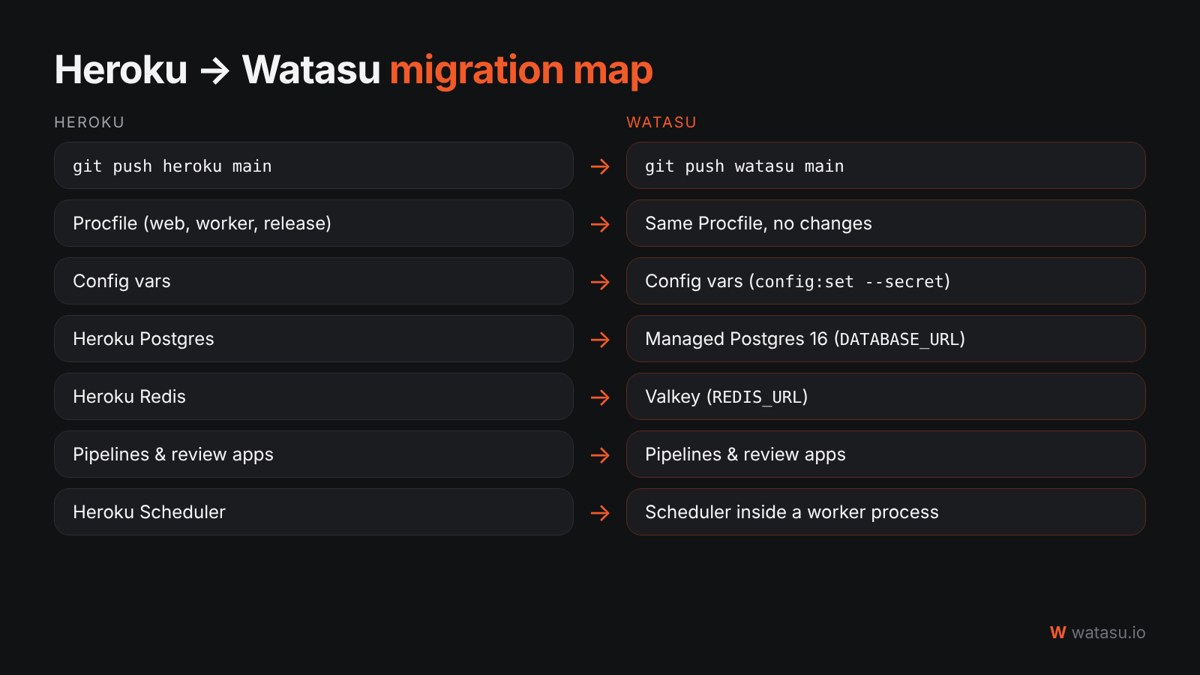
Start with a staging deployment to check compatibility before switching traffic.
- Install the CLI and create the app you will deploy:
watasu create my-app. - Keep your Procfile. Web, worker and release processes work the same way.
- Copy config vars. Import ordinary settings separately from secrets. Use the connection variables injected by Watasu for managed databases, and keep local environment files out of Git.
- Move Postgres: create the add-on, then restore a
pg_dumpfrom Heroku. - Replace add-ons: Heroku Redis → Valkey, Bucketeer/S3 → Watasu object storage, Papertrail → built-in logs.
- Move cron jobs from Heroku Scheduler into a scheduler inside a worker.
- Deploy and switch DNS: rehearse the database restore and verify workers in staging. Pause writes as needed, move the final data, update DNS, and verify TLS and app health.
Which Heroku alternative should you choose?
- EU startup that loves the Heroku workflow: Watasu.
- Hobby projects on a budget: Render’s free tier.
- Global users and low latency: Fly.io.
- Frontend-heavy Node app: Vercel.
- You want your own cloud account: Northflank or another BYOC platform.
- Full control on your own server: Dokku, Coolify, CapRover or Kamal.
Heroku taught a generation of developers that deployment should be one command. In this post we compared the main ways to keep that promise. The best Heroku alternatives keep that promise. If you are building in Europe, create a Watasu account and deploy your first app with the workflow you already know.
Frequently asked questions
Is Heroku end of life?
Heroku remains supported. It announced a sustaining engineering model in February 2026 and announced new platform features in October.
What can you do with Heroku?
Heroku hosts web apps, APIs, and workers. It supports Git deployment, dynos, pipelines, review apps, managed add-ons, and scheduled jobs.
Is Heroku free for hosting?
Heroku no longer offers free hosting. Eco dynos cost $5/month and sleep after inactivity. Databases and other add-ons are billed separately.
Which is better, Heroku or Render?
Render is a good fit for eligible free prototypes or teams that want built-in cron jobs and Blueprints. Heroku may fit teams that rely on its add-on marketplace or existing deployment workflow.